
Introduction
Seeing offers that say “buy verified Payoneer accounts” can feel tempting when you urgently need to receive international payments. But the truth is simple: buying a verified financial account can put your money, identity, business, and future payment access at serious risk.
Payoneer verifies users through identity and document checks, including government-issued ID, proof of address, and bank verification documents in many cases. That means a “ready-made” verified account is usually tied to someone else’s personal or business identity, which can create major compliance and security problems.
Instead of trying to shortcut the process, it is safer to open your own account with accurate information and complete the verification steps properly. Payoneer itself warns users to use real details during registration because inconsistencies may lead to account blocking or support issues.
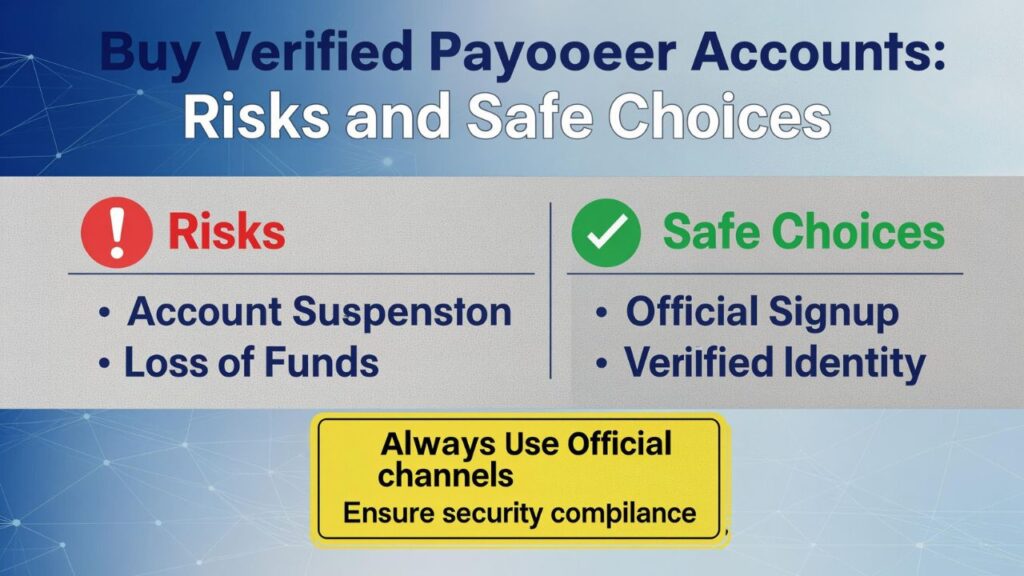
Table of Contents
- What Does “Buy Verified Payoneer Accounts” Mean?
- Why Buying a Verified Payoneer Account Is Risky
- How Payoneer Verification Works
- Common Scams Behind Verified Account Sellers
- Safer Alternatives to Buying Accounts
- How to Open and Verify Payoneer the Right Way
- How to Protect Your Payoneer Account
- What to Do If Your Account Is Restricted
- FAQs
- Conclusion
What Does “Buy Verified Payoneer Accounts” Mean?
The phrase “buy verified payoneer accounts” usually refers to sellers offering Payoneer accounts that are already registered, approved, or document-verified.
These accounts may be advertised as:
- Fully verified Payoneer accounts
- Aged Payoneer accounts
- Business Payoneer accounts
- Payoneer accounts with receiving details
- Ready-to-use freelance payment accounts
- Region-specific Payoneer accounts
On the surface, the offer may look easy. You pay a seller, receive login details, and start using the account. In reality, that account may be connected to another person’s identity, bank documents, address, tax details, business profile, or payment history.
That is where the danger starts.
Why Buying a Verified Payoneer Account Is Risky
A verified payment account is not just an email and password. It is connected to identity checks, financial records, security monitoring, and compliance rules.
You May Lose Access Anytime
If Payoneer detects mismatched information, unusual login behavior, suspicious payments, or inconsistent documents, the account may be restricted or closed. Payoneer states that it monitors transactions to prevent fraud, identity theft, phishing, and other threats.
The Account May Not Be Yours Legally
A purchased account may belong to another person. That means the original owner, seller, or scammer may still have recovery access.
Your Funds Can Be Frozen
If payments enter an account that later fails verification or triggers a review, your balance may be delayed, limited, or inaccessible.
You Could Receive Dirty or Disputed Funds
Some sellers recycle accounts previously used for spam, fraud, chargebacks, fake invoices, or marketplace abuse.
You Risk Identity and Business Damage
Using someone else’s verified financial profile can create problems with clients, marketplaces, tax records, and business reputation.
How Payoneer Verification Works
Payoneer verification exists to confirm that the person or business using the account is real.
According to Payoneer’s verification guidance, individuals may be asked for documents such as government-issued ID, proof of address, and bank verification documents. Business users may need company verification documents depending on business type.
Payoneer also explains that users can submit required documents through the Verification Center after signing in. These may include government-issued photo ID and business details where needed.
Common Verification Documents
| Verification Item | Purpose |
|---|---|
| Government-issued ID | Confirms legal identity |
| Proof of address | Confirms residence or business location |
| Bank document | Confirms banking ownership |
| Business registration | Confirms company legitimacy |
| Additional documents | Supports account review when needed |
| This is why buying a verified account creates a serious mismatch. The account may be verified, but not for you. |
Common Scams Behind Verified Account Sellers
Many people searching for “buy verified payoneer accounts” are trying to solve a real problem. Maybe their country has limited payment options. Maybe their account is under review. Maybe a freelance platform requires Payoneer. Scammers know this and use urgency to pressure buyers.
Fake Screenshot Scam
The seller shows screenshots of a “verified” dashboard, takes payment, then disappears.
Recovered Account Scam
The seller gives you access, waits until money enters the account, then recovers it through email, phone, or identity documents.
Stolen Identity Account
The account may be opened with stolen or fake documents. This can create serious legal and financial risk for anyone using it.
Restricted Account Scam
The account may already be limited, blocked, or flagged. You may only discover this after paying.
Marketplace Trap
Some sellers claim the account works with Fiverr, Upwork, Amazon, or other platforms. If the names do not match, payments can fail or trigger reviews.
Safer Alternatives to Buying Accounts
Instead of trying to buy verified payoneer accounts, use safer options that protect your money and reputation.
Open Your Own Payoneer Account
Use your real name, real address, real business details, and valid documents.
Fix Verification Problems
If your account is under review, submit clearer documents and contact Payoneer support through official channels.
Use a Business Account Properly
If you operate a company, register with your correct business details.
Use Alternative Payment Platforms
Depending on your country and client, you may also consider Wise Business, direct bank transfer, Stripe, PayPal, bank wire, or marketplace-supported payment methods.
Ask the Client for Another Payment Route
Professional clients usually understand payment limitations. Ask for a compliant method instead of risking a purchased account.
How to Open and Verify Payoneer the Right Way
Opening your own account may take more time, but it is safer.
Step 1: Register With Accurate Information
Use your real legal name, date of birth, address, phone number, and business details if applicable.
Step 2: Add Your Own Bank Information
Use a bank account that matches your identity or business.
Step 3: Submit Verification Documents
Payoneer may request government-issued ID, proof of address, and bank verification documents.
Step 4: Check the Verification Center
Payoneer instructs users to go to Settings and then Verification Center to see document requests and submit required information.
Step 5: Wait for Review
Do not submit fake or edited documents. If a document is rejected, upload a clearer valid version.
How to Protect Your Payoneer Account
A verified account still needs strong security.
Payoneer says it uses fraud monitoring, multi-factor authentication, and security updates to protect accounts and transactions.
Security Tips
- Use a strong unique password
- Enable two-factor authentication where available
- Never share login details
- Do not buy or rent accounts
- Avoid public Wi-Fi for financial logins
- Check payment activity regularly
- Use official Payoneer support only
- Watch for phishing emails and fake login pages
Payoneer also warns users about phishing and advises contacting support immediately if an account may have been compromised.
What to Do If Your Account Is Restricted
Account restrictions are stressful, but buying another account is not the answer.
Do This Instead
- Log in through the official Payoneer website.
- Check the Verification Center.
- Submit any requested documents.
- Make sure your documents are clear and valid.
- Contact Payoneer support if the issue remains.
- Do not create duplicate accounts without permission.
- Do not use someone else’s account to receive your payments.
Payoneer notes that accounts may be closed or blocked for reasons including age restrictions, restricted countries, and other eligibility issues.
FAQs
Is it safe to buy verified Payoneer accounts?
No. It can expose you to account loss, stolen funds, identity misuse, compliance issues, and platform payment problems.
Can I use someone else’s verified Payoneer account?
You should not use another person’s verified financial account. Payment accounts should match the real owner, documents, bank details, and business activity.
Why do sellers offer verified Payoneer accounts?
Some sellers target people who are desperate to receive international payments. Many offers are scams, stolen accounts, or accounts that can be recovered later.
What happens if Payoneer detects mismatched information?
The account may be reviewed, restricted, blocked, or closed depending on the issue.
What documents does Payoneer ask for?
Payoneer may request government-issued ID, proof of address, bank verification documents, and business documents depending on the account type.
What should I do if my Payoneer verification fails?
Check the reason, upload clearer valid documents, make sure details match, and contact Payoneer support through official channels.
Can I create a Payoneer account without buying one?
Yes. The safer route is to register with your own accurate details and complete verification directly.
How can I avoid Payoneer scams?
Avoid account sellers, never share login details, use official support, enable security settings, and watch for phishing pages.
Conclusion
Buying a verified financial account may look like a shortcut, but it can quickly become a costly mistake. The account may not be truly yours, the seller may recover it, Payoneer may restrict it, and your money may be trapped.
A safer path is to create your own Payoneer account, submit real documents, follow verification steps, and protect your login carefully. It may take more patience, but it protects your payments, identity, and business reputation.