
A well-chosen book shelf can change more than the way you store books. It can give an empty wall purpose, make a room feel more finished, display the objects that tell your story, and turn a neglected corner into a place you actually enjoy using.
The difficulty is that shelving has to do several jobs at once. It must fit the available space, support the weight placed on it, suit the room’s style, and remain practical after the initial styling is complete. This guide explains how to choose, place, organize, and decorate shelving so it looks intentional without becoming difficult to maintain.
You will find ideas for compact apartments, family living rooms, bedrooms, offices, and dedicated reading spaces. Along the way, we will compare freestanding and built-in options, look at useful proportions, and explore bookshelf ideas that work for both serious collections and decorative displays.
The goal is not to copy a showroom. It is to create storage that reflects how you live. Whether you prefer a pared-back book shelf, a colorful wall of novels, or flexible modular units, the right solution should feel natural in the room and easy to use every day.
What Is a Book Shelf and What Should It Do?
A book shelf is a horizontal surface or a group of horizontal surfaces designed to hold books and other items. It may be part of a freestanding case, attached directly to a wall, built into an alcove, or included within a larger storage system. Although the terms are often used interchangeably, a bookshelf commonly refers to the full piece of furniture, while a shelf can describe one individual level.
Good shelving should provide stable storage, convenient access, and enough visual order to keep the room from feeling crowded. The right choice depends on the size of your collection, the weight of your books, the wall area available, and whether you want the unit to blend in or become a focal point.
Begin With the Collection, Not the Furniture
Before browsing book shelves, count or roughly estimate what you need to store. Separate standard paperbacks, large hardbacks, magazines, albums, files, and decorative objects. A collection dominated by art books needs deeper and taller openings than a collection of small novels.
Leave some open capacity rather than filling every level immediately. Empty space makes it easier to add future purchases and gives displayed objects room to breathe. It also helps prevent the crowded look that can make even the best bookshelf feel visually heavy.
Decide Whether Storage or Display Matters More
Storage-led shelving prioritizes capacity, adjustable levels, and efficient use of wall space. Display-led shelving uses more negative space and may include art, plants, lamps, or sculptural objects. Many successful book shelf ideas combine both approaches by dedicating lower levels to dense storage and upper levels to lighter arrangements.
If children use the room, place their books within easy reach and reserve fragile objects for higher levels. In a home office, files and reference books may need to remain closer to the desk. The arrangement should support the habits of the people who use the room rather than following a decorative formula.
How to Measure Shelving Correctly
Before buying a book shelf, measure the total wall width, ceiling height, skirting or baseboard projection, nearby door swings, window positions, outlets, radiators, and floor vents. Also note whether the floor or wall is uneven, particularly in older homes.
A book shelf should have enough clearance to look deliberate and to allow doors, drawers, and adjacent furniture to function. Mark the planned width and height with removable painter’s tape. Viewing the outline from across the room often reveals whether the piece feels too small, too dominant, or properly balanced.
Choose a Practical Shelf Depth
Standard novels and paperbacks generally need less depth than albums, storage baskets, or oversized reference books. Excessively deep shelving can waste space and encourage books to disappear behind other objects. Very shallow shelving, however, may not safely support larger items.
Measure the deepest books you plan to store and add a small allowance. When considering a modern bookshelf with mixed open and closed storage, check the internal dimensions rather than relying only on the overall product depth.
Check Shelf Height and Adjustability
The best bookshelf often includes adjustable levels because they are easier to adapt. Group books by approximate height before setting the levels. This reduces wasted vertical space and lets you create a few taller openings for artwork, plants, or large-format books.
Among the best bookshelves, adjustability is often more valuable than an unusual shape. A visually striking unit can become frustrating when every compartment is too short, too narrow, or too irregular for the items you own.
Think About Weight and Stability
Books become heavy quickly, especially when placed across long spans. Review the manufacturer’s stated load capacity and avoid overloading a shelf. Long, thin boards may bow over time if they lack adequate central support.
Tall book shelves should usually be secured according to the manufacturer’s instructions, particularly in homes with children or pets. Use wall fixings suited to the wall type, and seek qualified help when you are uncertain about wiring, pipes, masonry, or the correct anchor.
Popular Types of Bookshelves
Different book shelves solve different problems. The most useful choice is not necessarily the trendiest; it is the one that suits the room, collection, budget, and level of permanence you want.
The following options offer a starting point for comparing bookshelf ideas before you buy or build anything.
Freestanding Bookcases
Freestanding units are flexible, widely available, and easy to move when a room changes. They work well for renters and for anyone who wants to expand a collection gradually. Matching units can be placed side by side to create the effect of a larger library wall.
A freestanding bookshelf should sit level and feel stable when loaded. Look for strong shelf supports, a rigid back panel or bracing, and an anchoring system. Open-backed models can feel lighter, but they may offer less resistance to side-to-side movement.
Built-In Shelving
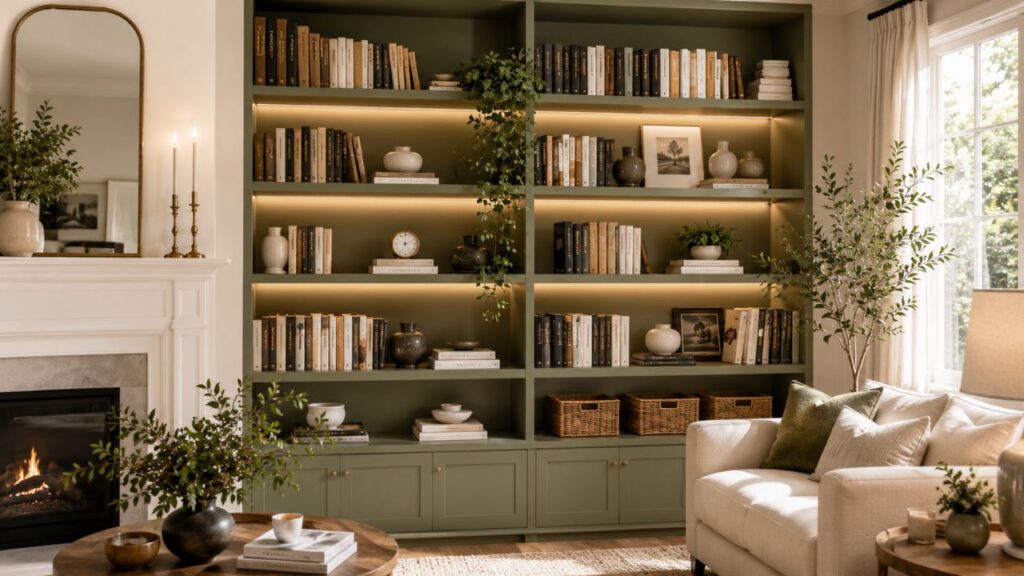
Built-ins make excellent use of alcoves, chimney breasts, awkward recesses, and full-height walls. They can be painted to match the room, wrapped around a doorway, or combined with cabinets below. Well-planned built-ins often look architectural rather than added later.
For homeowners seeking the best bookshelf for an unusually shaped room, custom work may provide the most efficient result. It usually costs more than flat-pack furniture, but it can eliminate unused gaps and create storage that fits the space precisely.
Floating Shelves
Floating shelves keep the floor clear and work well above desks, sofas, sideboards, and reading chairs. They can display a small collection without the visual weight of a full bookcase. Their clean lines also suit a modern bookshelf scheme.
Installation quality matters. The wall construction, bracket type, shelf length, and expected load must all be considered. Use floating shelves for a controlled number of books rather than assuming every wall-mounted design can support a dense library.
Book Storage Ideas for Every Room
The same arrangement of book shelves does not work equally well in every room. Living rooms need balance and display space, bedrooms benefit from calm organization, and offices require quick access to useful materials.
These book shelf ideas show how to adapt the basic principles to different parts of the home.
Living Room Shelving
In a living room, shelving often shares attention with the sofa, television, fireplace, and windows. For practical bookshelf inspo, use the largest architectural feature to guide the layout. A pair of units can frame a fireplace or media console, while a long low case can ground a large wall without overpowering it.
Some of the best bookshelves for living rooms combine open shelves with closed cabinets. Books and meaningful objects remain visible, while cables, games, paperwork, and everyday clutter can be hidden below.
Bedroom Shelving
Bedroom shelving should feel restful rather than busy. Keep the color palette restrained, avoid overfilling the levels, and leave enough room around the bed for comfortable movement. A narrow unit can replace a bulky bedside table when floor space is limited.
For calm bookshelf inspiration, arrange favorite reads with a small lamp, a framed photograph, and one or two personal objects. Closed baskets can hold chargers, notebooks, or items that would otherwise create visual noise.
Home Office Shelving
The best bookshelf for an office places frequently used references, files, and equipment within reach. Less-used archives can sit higher or farther from the desk. Labelled boxes and magazine holders help maintain order without making the room look purely functional.
A wall-to-wall book shelf can provide an impressive background for video calls, but it should still be practical. Keep the area directly behind your chair uncluttered, and avoid reflective objects or unstable stacks that distract on camera.
Styling a Bookshelf Without Making It Look Cluttered
Useful bookshelf ideas and realistic bookshelf inspo begin with storage that has already been planned. Place the books you actually need first, then add decorative objects in small groups. Work across the whole unit rather than completing one shelf at a time.
A thoughtfully styled bookshelf does not require expensive accessories. Family photographs, travel finds, handmade ceramics, small artworks, inherited objects, and natural materials usually create more character than a collection of items bought only to fill gaps.
Mix Vertical and Horizontal Books
Most books should stand vertically for easy access, but a few horizontal stacks can vary the rhythm and provide a base for a small object. Keep stacks manageable so removing one title does not require dismantling the entire arrangement.
This simple technique appears frequently in bookshelf inspo, but it works best when used sparingly. Too many stacks make shelves harder to browse and can create a staged appearance that is difficult to maintain.
Repeat Colors and Materials
Repeating a color, wood tone, metal finish, or ceramic texture helps separate objects feel connected. The repetition can be subtle: a black frame on one level, a black vase on another, and dark book spines elsewhere.
For a cohesive modern bookshelf, limit the number of finishes and allow the shelf material to remain visible. A few repeated elements are usually enough to create unity without turning the display into a rigid matching set.
Use Negative Space
Not every gap needs to be filled. Empty space gives the eye a place to rest and makes important objects easier to notice. It also leaves capacity for new books and helps the display evolve naturally.
Many bookshelf ideas online look appealing because they use less than the available space. Apply the principle selectively: dense storage can remain on lower shelves, while eye-level areas can be arranged more loosely.
Create Visual Balance, Not Perfect Symmetry
Exact symmetry can feel formal, while complete randomness may feel chaotic. Aim for balance by distributing visual weight. A large stack on one side might be balanced by a framed print or plant on the opposite side at a different level.
Useful bookshelf inspiration often comes from studying shape rather than copying specific products. Notice where large forms, dark colors, and open gaps appear, then recreate that balance with objects you already own.
Modern Bookshelf Design Ideas
Strong bookshelf inspiration is not limited to stark white furniture. Many cool bookshelves include warm wood, powder-coated metal, curved forms, concealed lighting, and sculptural arrangements, as long as the overall composition remains clear and purposeful.
A successful modern bookshelf usually combines strong lines with controlled styling. Choose fewer, better-scaled objects and avoid filling every compartment simply because space is available.
Floor-to-Ceiling Library Walls
Full-height shelving maximizes storage and gives a room architectural presence. Use consistent vertical divisions and include adjustable sections for flexibility. A library ladder can be attractive, but it must be properly specified and installed if it will be used rather than displayed.
Among the best bookshelves, a full wall system offers exceptional capacity. Break up the mass with cabinet doors, artwork, a window seat, or a central opening for a desk or television.
Asymmetrical and Geometric Units
Offset compartments, angled supports, and irregular grids can act as functional sculpture. These designs suit a smaller, curated collection better than thousands of books because unusual openings often reduce storage efficiency.
The strongest cool bookshelves balance novelty with usefulness. Before purchasing one, map your books against the compartment sizes and consider how the unit will look when partially empty as well as fully styled.
Low Horizontal Shelving
Low units preserve open wall space and can make ceilings appear higher. They work beneath windows, behind sofas, or along dining walls. The top surface provides room for art, lamps, plants, and larger objects.
A low unit can be the best bookshelf for an open-plan home because it defines an area without blocking sightlines. Ensure it is deep and stable enough for the intended use, especially when placed away from a wall.
Shelving With Integrated Lighting
Lighting can highlight book spines, art, and texture. Concealed LED strips create an even glow, while small directional fittings emphasize selected objects. Plan wiring early so cables and transformers remain accessible but discreet.
For refined bookshelf inspo, use warm, gentle light rather than intense illumination on every level. Lighting should add atmosphere and visibility, not make the shelving resemble a retail display.
Small-Space Shelving Ideas
Limited floor area does not mean giving up a collection. In small homes, cool bookshelves use height, overlooked corners, and furniture that performs more than one function.
Effective book shelf ideas for compact rooms begin with editing. Keep the books you value, relocate rarely used volumes, and avoid storing unrelated clutter in the same area unless the unit includes closed compartments.
Use the Space Above Doors and Desks
A shelf above a doorway can hold books that are not needed every day. Shelving above a desk keeps reference material close without using additional floor space. Make sure high storage remains safely reachable when access is required.
These placements create practical book shelf ideas for rooms where every metre matters. Paint the shelves to match the wall if you want them to recede, or use contrasting timber to make them an intentional feature.
Turn Corners Into Storage
Compact bookshelf inspo often turns corners into narrow towers, wraparound shelving, or small reading nooks. Avoid pushing two deep cases together in a way that makes one side inaccessible. Purpose-designed corner units generally use the space more effectively.
For compact bookshelf inspiration, pair a narrow corner unit with a comfortable chair, wall light, and small table. The result can feel like a dedicated library even within a bedroom or studio apartment.
Common Bookshelf Mistakes to Avoid
A beautiful unit can still fail if it blocks circulation, bows under weight, or becomes impossible to keep organized. Planning for real use is more important than achieving a perfect photograph on the first day.
Even creative book shelf ideas can fail when these common problems are ignored while evaluating book shelves or rearranging existing storage.
Buying Before Measuring
When comparing bookshelf ideas, remember that product photographs can make furniture look smaller than it is. Always compare the dimensions with the room and mark the outline. Remember to include cornices, skirting, doors, plugs, and the space needed for assembly.
A correctly scaled book shelf should relate to nearby furniture. A very narrow unit may look lost beside a large sofa, while a massive dark case can overwhelm a small wall.
Overloading Every Shelf
Dense rows are appropriate for a working library, but not every level has to contain the same amount. Mix full sections with lighter areas where possible, and keep the heaviest books lower to improve stability.
Even the best bookshelves can look chaotic when unrelated objects are squeezed into every gap. Use baskets or closed cabinets for small practical items that do not contribute to the display.
Organizing Only by Color
Color organization can be attractive, but it is not always practical for finding titles. It also separates series and subjects. Use it when visual impact matters more than browsing, or apply it to a smaller decorative section.
A functional bookshelf might be organized by genre, author, subject, size, or frequency of use, with color used only to guide the overall balance.
Ignoring the Top and Bottom
The top of a freestanding case can gather random items, while the lowest level can become a dumping ground. Plan both areas deliberately. Use the top for one or two larger objects and the bottom for heavy books, doors, or matching baskets.
This small change can elevate ordinary storage and create cool bookshelves without purchasing anything new.
FAQs About Book Shelves
What is the difference between a book shelf and a bookshelf?
A book shelf can describe one shelf used for books, while a bookshelf usually refers to the complete furniture unit containing several shelves. In everyday use, people often use both terms for the same type of storage.
How deep should shelving be for books?
Depth should match the collection. Standard novels need less space than albums, binders, or art books. Measure the deepest items and choose shelving that supports them without leaving excessive unused space behind the books.
What are the best bookshelves for a small room?
The best bookshelves for compact spaces are often tall, narrow, shallow, or multifunctional. Wall-mounted shelves, corner units, low cases beneath windows, and shelving integrated with desks or benches can preserve valuable floor area.
How should books be arranged on a shelf?
Arrange books according to how you use them. Genre, author, subject, size, and frequency are all practical systems. Add a few horizontal stacks for variety, but keep most titles accessible and avoid unstable piles.
Are floating shelves suitable for heavy books?
Some floating shelves can support books, but capacity depends on the shelf construction, bracket system, fixing method, wall type, and span. Follow the manufacturer’s limits and use appropriate professional advice when installation conditions are uncertain.
How do I find bookshelf inspiration that suits my home?
Look for bookshelf inspiration from rooms with similar proportions, lighting, and storage needs rather than copying a single styled image. Save examples that share recurring features, such as warm wood, closed lower cabinets, or restrained decoration.
What makes cool bookshelves practical as well as stylish?
The most useful cool bookshelves combine an interesting shape or finish with stable construction, sensible compartment sizes, adequate capacity, and easy access. A striking design is successful only when it still holds the items you need.
Conclusion
The right book shelf is more than a place to line up books. It can organize a room, express personal interests, support daily routines, and turn unused wall space into something both useful and beautiful.
Start with accurate measurements and the needs of your collection, then choose a type that suits the room and your level of permanence. Whether your preference is a fitted library, a flexible modular system, or a restrained modern bookshelf, thoughtful planning will produce a result that remains practical long after the styling is finished.