
Introduction
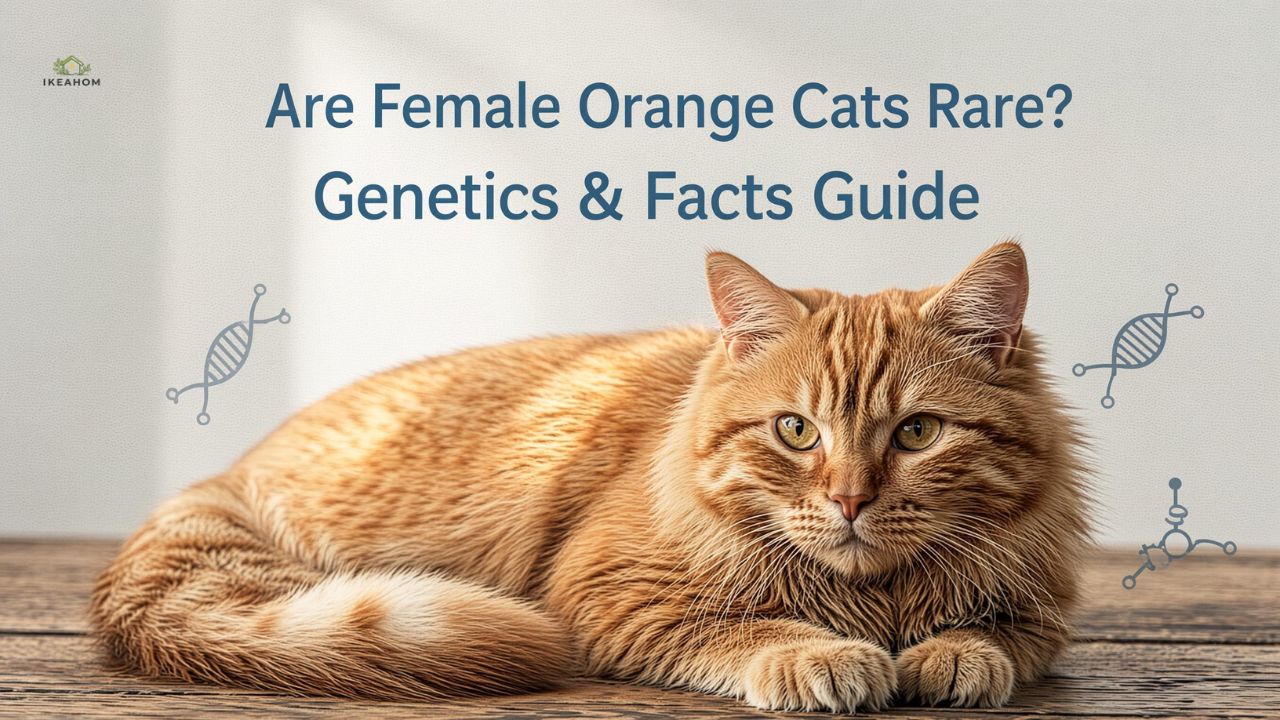
Have you ever seen an orange cat and instantly wondered, “Wait… is this one a girl?” You are not alone. Many cat lovers ask, are female orange cats rare, because most orange cats people meet seem to be male.
The short answer is yes, female orange cats are less common than male orange cats. They are not impossible, mythical, or once-in-a-lifetime rare, but they are unusual enough to make people curious.
The reason sits inside cat coat-color genetics. Orange coloring in cats is linked to the X chromosome, so male and female cats inherit and express orange fur differently. Recent genetic studies have also identified a deletion near the ARHGAP36 gene on the X chromosome as the reason behind orange cat coloring.

Table of Contents
- Are Female Orange Cats Rare?
- Why Most Orange Cats Are Male
- The Simple Genetics Behind Orange Female Cats
- How Rare Are Female Orange Cats Compared to Male Orange Cats?
- Are All Orange Cats Tabby Cats?
- Orange Female Cats vs Calico and Tortoiseshell Cats
- Are Female Orange Cats Different in Personality?
- Do Female Orange Cats Have Special Health Issues?
- How to Tell If an Orange Cat Is Female
- Myths About Female Orange Cats
- Caring for a Female Orange Cat
- FAQs
- Conclusion
Are Female Orange Cats Rare?
Yes, female orange cats are rare compared with male orange cats. A commonly cited estimate is that about 80% of orange tabby cats are male, meaning only about 20% are female. Pet education sources such as Chewy and Catster use this same broad estimate, while noting that the exact number can vary by local cat population.
That means if you meet five orange cats, there is a good chance only one of them will be female. Of course, real life is not perfectly mathematical. One shelter may have several orange females at once, while another may go months without seeing one.
So when people ask, “are female orange cats rare,” the honest answer is: rare enough to be special, but not so rare that you should assume every orange cat is male.
What “Rare” Really Means Here
Rare does not always mean extremely valuable, exotic, or genetically abnormal. In this case, rare simply means less common in the general orange-cat population.
A female orange tabby can be perfectly healthy, normal, playful, affectionate, shy, bossy, quiet, silly, or anything in between. Her color is unusual because of inheritance patterns, not because she is a different type of cat.
Why Most Orange Cats Are Male
The reason most orange cats are male comes down to sex chromosomes. Female cats usually have two X chromosomes, while male cats usually have one X chromosome and one Y chromosome.
The orange coat-color trait is carried on the X chromosome. Since male cats have only one X chromosome, they need only one orange version of the gene to appear orange. Female cats have two X chromosomes, so they usually need orange-linked information on both X chromosomes to become fully orange.
That simple difference creates a big shift in numbers.
A Simple Way to Picture It
Think of the X chromosome like a color instruction card.
A male cat gets one X card from his mother. If that card says “orange,” he can be orange.
A female cat gets one X card from her mother and one X card from her father. To be fully orange, both cards generally need to carry the orange instruction.
That is why female orange cats need a more specific genetic combination than males.
Why the Father Matters for Female Orange Kittens
For a female kitten to be orange, her father must usually pass along an orange X chromosome. Since fathers pass their X chromosome only to daughters, the male parent plays a direct role in whether daughters can be orange.
The mother also has to contribute an orange-linked X chromosome. If the mother does not carry orange, a daughter will not usually become fully orange.
This is why orange female kittens are less common than orange male kittens.
The Simple Genetics Behind Orange Female Cats
The science became even more interesting in 2025, when researchers identified the genetic basis for orange coats in domestic cats. Two studies in Current Biology connected orange coloring with a deletion near the X-linked ARHGAP36 gene, which changes pigment activity in the fur.
Kyushu University explained that a small deletion on the X chromosome lies behind orange coats in ginger cats and orange patches in calico and tortoiseshell cats.
This matters because it supports what cat breeders and geneticists had suspected for a long time: orange coloring behaves as a sex-linked trait.
What Is Sex-Linked Color?
A sex-linked trait is connected to a sex chromosome, usually the X chromosome. Since males and females have different sex chromosome combinations, the trait can show up differently in each sex.
For orange cats, that means:
- Males need one orange-linked X chromosome.
- Females usually need two orange-linked X chromosomes to be fully orange.
- Females with one orange-linked X chromosome and one non-orange version may become tortoiseshell or calico.
This is the core answer to the question, are female orange cats rare.
Why Female Cats Can Have Mixed Colors
Female cats have two X chromosomes, but each cell does not use both in the same way. In many cells, one X chromosome becomes inactive. This process is called random X-chromosome inactivation.
That is why some female cats show orange patches mixed with black or brown patches. One group of cells may express orange, while another group expresses non-orange coloring. This is the genetic basis of tortoiseshell and calico patterns.
The Stanford Medicine report on the orange-cat gene explains that the mutation affects pigment cells and appears to influence color rather than proven behavior traits.
How Rare Are Female Orange Cats Compared to Male Orange Cats?
The widely repeated estimate is that around one in five orange cats is female. In plain words, female orange cats are uncommon but not shockingly rare.
However, the exact ratio can shift depending on the breeding population. In an area with many orange cats, orange females may be easier to find. In another area, they may feel almost impossible to spot.
Orange Cat Sex Ratio Table
| Orange Cat Type | How Common? | Basic Genetic Reason |
|---|---|---|
| Male orange cat | More common | Needs one orange-linked X chromosome |
| Female orange cat | Less common | Usually needs orange-linked versions from both parents |
| Female tortoiseshell | Commonly female | Often has one orange and one non-orange X pattern |
| Female calico | Commonly female | Similar X-linked color pattern with white spotting |
| Male calico | Very rare | Usually linked to unusual chromosome patterns |
Does Breed Affect the Chance?
Orange coloring can appear in many breeds and mixed-breed cats. It is not limited to one specific breed.
You may see orange females in:
- Domestic shorthairs
- Domestic longhairs
- Maine Coons
- Persians
- British Shorthairs
- American Shorthairs
- Scottish Folds
- Exotic Shorthairs
- Munchkins
- Oriental-type cats
Mixed-breed cats are common in shelters, so many orange female cats people meet are domestic shorthairs or domestic longhairs.
Are All Orange Cats Tabby Cats?
Most orange cats show tabby markings, even if the pattern is soft or faint. That is why people often say “orange tabby” instead of simply “orange cat.”
Orange fur usually reveals some kind of tabby pattern because the orange pigment often allows striping, swirls, spots, or ticking to show through.
Common Orange Tabby Patterns
| Pattern Type | What It Looks Like |
|---|---|
| Classic tabby | Bold swirls or bullseye shapes on the sides |
| Mackerel tabby | Narrow stripes like tiger stripes |
| Spotted tabby | Spots or broken stripes |
| Ticked tabby | Speckled coat with less obvious body striping |
| Patched tabby | Orange tabby areas mixed with other colors |
The Famous “M” Marking
Many orange tabbies have an “M” shape on the forehead. It is not a sign of rarity, breed, or personality. It is simply a common feature of tabby patterning.
People love making stories about it, though. Some say the “M” stands for mystery, mischief, or magic. Science does not back those meanings, but it is easy to understand why cat owners enjoy them.
Orange Female Cats vs Calico and Tortoiseshell Cats
Female orange cats are closely related to the same genetic conversation people have about calico and tortoiseshell cats.
A fully orange female usually receives orange-linked color information from both parents. A tortoiseshell or calico female often has one orange-linked X chromosome and one non-orange X chromosome.
Tortoiseshell Cats
Tortoiseshell cats have a mix of orange and black or brown colors. Their coats can look marbled, mottled, brindled, or patched.
Most tortoiseshell cats are female because the pattern depends on two X chromosomes and random X inactivation.
Calico Cats
Calico cats have white fur with orange and black patches. The white spotting gene adds the bright white background, while the orange and black patches come from X-linked color expression.
Like tortoiseshell cats, calicos are almost always female. Male calicos exist, but they are very uncommon and often linked with an extra sex chromosome.
Fully Orange Female vs Calico Female
A fully orange female is not the same as a calico. A calico has clear white areas and patches of orange and black. A female orange cat is mostly orange, though she may have white on the chest, paws, face, or belly.
Both are linked to X-chromosome genetics, but they express color differently.
Are Female Orange Cats Different in Personality?
Orange cats have a huge online reputation. People call them chaotic, friendly, bold, goofy, cuddly, dramatic, and sometimes “one-brain-cell cats.” It is funny, and many orange cat owners enjoy the joke.
However, there is no strong scientific proof that female orange cats have a fixed personality just because of their coat color.
Stanford Medicine noted that current observations suggest the orange mutation specifically affects color, while orange cat behavior remains an open question needing stronger research.
What Really Shapes a Cat’s Personality?
A cat’s behavior is influenced by many things:
- Genetics beyond coat color
- Early socialization
- Breed background
- Home environment
- Handling as a kitten
- Stress levels
- Health
- Age
- Spay or neuter status
- Daily routine
A female orange cat may be sweet and clingy. Another may be independent and serious. Another may scream at closed doors and steal bread from the kitchen counter.
That is the beauty of cats. They rarely follow the script.
Why People Think Orange Cats Are Extra Friendly
There may be a few reasons behind the stereotype.
First, many orange cats are male, and neutered male cats are often described by owners as social or laid-back. Second, memorable orange cats in cartoons, movies, and internet culture have shaped expectations. Third, people tend to remember funny behavior when it matches a popular belief.
Still, a cat’s coat is not a personality guarantee.
Do Female Orange Cats Have Special Health Issues?
Female orange cats do not automatically have special health problems because they are orange.
The orange coat-color gene affects pigment, but current public reporting from the recent studies does not show that being orange makes a cat sick. Stanford Medicine specifically described the mutation as affecting color based on current observations, while behavior and broader effects need more research.
Normal Cat Health Still Matters
A female orange cat needs the same basic care as any other cat:
- Regular vet checkups
- Vaccinations
- Parasite prevention
- Dental care
- Healthy diet
- Weight management
- Clean litter box
- Safe indoor or supervised outdoor environment
- Spaying unless part of an ethical breeding program
Watch Weight Carefully
Some orange cats have a reputation for loving food. Whether that is genetics or just cat culture is not clear, but weight control matters for every cat.
Obesity can increase the risk of diabetes, arthritis, liver issues, and reduced quality of life. Your vet can help you choose a feeding amount based on age, body condition, activity, and health status.
Spaying a Female Orange Cat
If your orange cat is female and not part of a responsible breeding plan, spaying is usually recommended. It prevents unwanted litters and reduces certain reproductive health risks.
A female orange cat can pass orange-linked genetics to her kittens, but breeding should never be done only because her coat color is unusual.
How to Tell If an Orange Cat Is Female
Color alone cannot confirm sex. Since most orange cats are male, people may guess male first, but that guess can be wrong.
The only reliable ways to tell are checking the cat’s anatomy, asking a veterinarian, or reviewing shelter or breeder records.
Physical Clues
Adult male cats may have a larger head, broader cheeks, or visible testicles if not neutered. However, neutered males and females can look very similar.
Kittens are especially tricky. Even experienced cat owners sometimes misidentify kitten sex.
Ask a Vet or Shelter Worker
A veterinarian or trained shelter worker can usually confirm sex quickly. This is the safest option if you are unsure.
Do Not Assume Based on Name or Color
An orange cat named Pumpkin, Simba, Ginger, or Marmalade could be male or female. Names and coat colors are not reliable.
This is why the question “are female orange cats rare” often comes up after someone discovers their orange kitten is actually a girl.
Myths About Female Orange Cats
Female orange cats attract a lot of little myths because their color feels special.
Myth 1: Female Orange Cats Are Impossible
False. Female orange cats absolutely exist. They are just less common than males.
Myth 2: Every Orange Cat Is Male
False. Most orange cats are male, but a meaningful minority are female.
Myth 3: Female Orange Cats Are Always Expensive
Not necessarily. A female orange cat at a shelter may have a normal adoption fee. Some breeders may charge based on breed, pedigree, and demand, but sex and color alone should not be treated like a luxury product.
Myth 4: Female Orange Cats Are Always More Affectionate
Not proven. Some are affectionate, some are reserved, and some are tiny orange queens with firm opinions about everything.
Myth 5: Orange Female Cats Are a Separate Breed
False. Orange is a coat color, not a breed.
Myth 6: Female Orange Cats Cannot Have Kittens
False. A healthy unspayed female orange cat can reproduce. Her kitten colors will depend on the genetics of both parents.
Caring for a Female Orange Cat
Once the genetics question is answered, the real joy begins: caring for the cat in front of you.
Whether she is rare or not, she needs a safe, loving home and a routine that supports her health.
Give Her a Comfortable Routine
Cats feel safer when daily life is predictable. Feed her at regular times, keep the litter box clean, and give her a cozy sleeping place.
Enrich Her Environment
Cats need stimulation. Even indoor cats are hunters at heart.
Good enrichment ideas include:
- Wand toys
- Puzzle feeders
- Cat trees
- Window perches
- Scratching posts
- Cardboard boxes
- Treat hunts
- Safe climbing spots
Protect Her Coat and Skin
Orange fur can look bright and beautiful, but coat health depends on diet, grooming, and overall wellness.
Brush her regularly, especially if she is longhaired. Watch for dandruff, bald patches, fleas, or overgrooming.
Keep Her Safe Outdoors
Outdoor cats face risks from traffic, predators, disease, parasites, and fights. If she enjoys fresh air, consider a catio, harness walks, or supervised garden time.
Respect Her Personality
Some cats love being held. Others prefer sitting beside you instead of on you. Some want playtime before cuddles. Others want food first and affection later.
A good cat owner learns the cat’s language instead of forcing a fantasy personality onto her.
Why Female Orange Cats Feel So Special
Part of the charm is the surprise. People expect orange cats to be boys, so meeting an orange girl feels like finding a tiny secret hidden in plain sight.
There is also something warm and cheerful about orange fur. Ginger, marmalade, pumpkin, honey, cinnamon, apricot—people reach for cozy words because the color feels happy.
But the real reason a female orange cat feels special is not only genetics. It is the little things: the way she curls her tail, chirps at birds, steals your chair, blinks slowly from across the room, or decides that your clean laundry is now her royal bed.
That is what makes any cat unforgettable.
Should You Adopt a Female Orange Cat?
If you find a female orange cat at a shelter, do not adopt her only because she is uncommon. Adopt her because her age, temperament, energy level, and care needs fit your home.
A shy older orange female may be perfect for a quiet apartment. A bold kitten may need a playful household. A longhaired orange girl may need more grooming than a shorthaired one.
Good Questions to Ask Before Adoption
- Is she spayed?
- Has she been vaccinated?
- Does she like other cats?
- Has she lived with dogs?
- Is she comfortable with children?
- Does she have any medical needs?
- Is she shy, playful, vocal, or independent?
- What food is she eating now?
- Does she use the litter box reliably?
The best match is not always the rarest cat. It is the cat whose needs you can meet with patience and love.
Are Female Orange Cats Rare in Shelters?
They can be harder to find than male orange cats, but shelters do get them. Availability depends on the local cat population, season, rescue intake, and adoption demand.
If you specifically want a female orange cat, you may need to wait. You can check local shelters, rescue groups, foster networks, and adoption websites.
That said, try to stay open-minded. A tortoiseshell, calico, brown tabby, black cat, or gray kitten may surprise you just as much.
Why You Should Not Rush
Wanting a certain color is normal. Many people have a dream cat in mind. However, personality and health are more important than color.
If you choose only by coat, you may miss the cat who would actually fit your life better.
The Genetics in a Simple Breeding Example
Let’s keep this simple. Imagine an orange male cat and a female cat that carries orange on one X chromosome.
Their kittens have a higher chance of producing orange females than kittens from a non-orange father.
Basic Example Table
| Parent Combination | Possible Result |
|---|---|
| Orange father + orange mother | Female kittens can be orange |
| Orange father + tortoiseshell mother | Some female kittens may be orange |
| Non-orange father + orange mother | Male kittens may be orange, female kittens usually may not be fully orange |
| Orange father + non-orange mother | Female kittens may be tortoiseshell rather than fully orange |
| This table is simplified, but it shows why both parents matter for female orange kittens. |
Are Female Orange Cats More Valuable?
Emotionally, every loved cat is valuable. Financially, a female orange cat is not automatically worth more.
Price depends on:
- Breed
- Pedigree
- Health testing
- Breeder reputation
- Location
- Demand
- Registration papers
- Age
- Veterinary care already provided
A mixed-breed female orange kitten should not be priced like a rare collectible simply because she is orange. Be careful with sellers who overhype rarity without offering health records, ethical care, or transparency.
Adoption Is Often the Better Route
Many wonderful orange cats, including females, enter shelters and rescues. Adoption fees usually support vaccinations, spay/neuter surgery, microchipping, and rescue work.
If you care more about companionship than pedigree, adoption is a kind and practical choice.
FAQs
Are female orange cats rare?
Yes, female orange cats are less common than male orange cats. A common estimate is that around 20% of orange tabby cats are female, though the number can vary by population.
Why are most orange cats male?
Most orange cats are male because orange coloring is linked to the X chromosome. Males need only one orange-linked X chromosome, while females usually need orange-linked versions from both parents.
Can female orange cats exist?
Yes, female orange cats definitely exist. They are uncommon, not impossible.
Are all orange cats tabby cats?
Most orange cats show tabby markings, even if the stripes or patterns are faint. Orange cats commonly have classic, mackerel, spotted, or ticked tabby patterns.
Are female orange cats sterile?
No. A typical female orange cat is not sterile just because she is orange. If she is healthy and unspayed, she can usually reproduce.
Are female orange cats more expensive?
Not automatically. A purebred orange female may cost more because of breed and pedigree, but a mixed-breed female orange cat should not be treated as a luxury item only because of color.
Do female orange cats have different personalities?
There is no strong proof that female orange cats have one fixed personality type. Behavior depends on genetics, socialization, health, age, and environment.
Is an orange female cat the same as a calico?
No. A female orange cat is mostly orange. A calico has white fur with orange and black patches. Both involve X-linked color genetics, but the coat patterns are different.
How can I know if my orange kitten is female?
The best way is to ask a veterinarian or trained shelter worker. Coat color alone cannot confirm sex.
Should I adopt a female orange cat?
Yes, if her personality, age, health, and needs fit your home. Her rare color is fun, but her care needs and temperament matter more.
Conclusion
So, are female orange cats rare? Yes, they are less common than male orange cats because orange coat color is linked to the X chromosome. Male cats need only one orange-linked X chromosome, while female cats usually need the right orange-linked combination from both parents.
But rare does not mean impossible, unhealthy, or magical. A female orange cat is still a normal cat with her own personality, habits, preferences, and needs.
If you are lucky enough to share life with one, enjoy the genetics lesson—but love the cat herself even more. Her orange coat may be uncommon, but her real charm comes from the everyday moments: the purrs, the mischief, the slow blinks, and the way she quietly becomes part of the family.